Configuration
Strict setup, project and step configuration ownership for openAMUNDSEN-DA.
Hierarchy
<setup-name>.yml- setup-wide openAMUNDSEN config.<project-name>.yml- project-specific data assimilation config and time span.step_XX.yml- auto-generated step windows.
Generic setup.yml and project.yml aliases are not accepted.
The setup root must contain exactly one non-legacy .yml file. This keeps the
configuration unambiguous when Docker mounts a named setup directory as
/data; the logical setup filename does not change at the mount boundary.
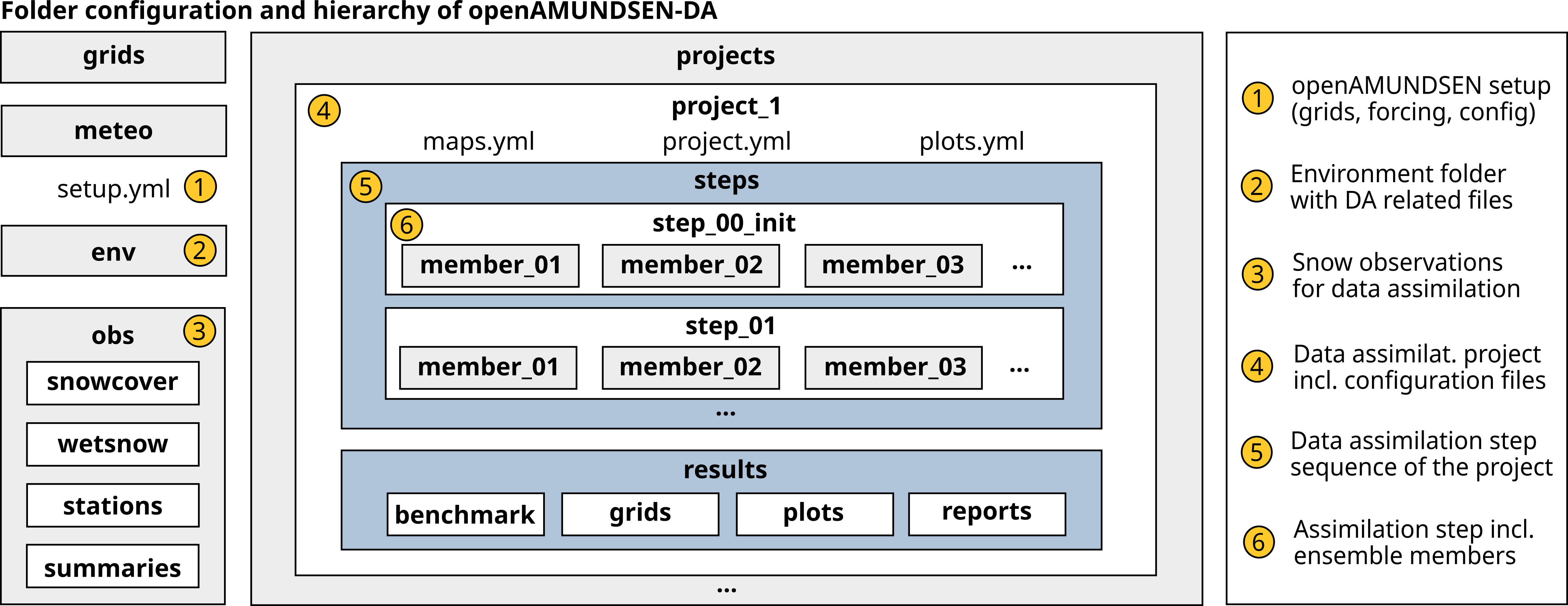
Configuration ownership from the shared openAMUNDSEN setup through one data assimilation project to generated step windows.
<setup-name>.yml (setup level)
Use setup YAML for stable, shared settings that apply to all projects.
Typical keys:
domain,resolution,timestep,crs,timezone- openAMUNDSEN model and output settings
- environment block (
GDAL_DATA,PROJ_LIB, …)
Example:
domain: rofental
resolution: 100
timestep: 3H
crs: epsg:32632
timezone: 1

output_data:
  grids:
    format: netcdf
    variables:
      - var: snow.swe
        name: swe
        freq: D
      - var: snow.depth
        name: hs
        freq: D
      - var: snow.lwc
        name: lwc
        freq: D
Do not place obs or data_assimilation in setup YAML.
output_data.grids.format is required and selects the one model-grid reader.
Use netcdf for grid-layout NetCDF or geotiff for deterministic,
georeferenced daily GeoTIFFs. Mixed artifacts and NetCDF roi_pixel layout are
rejected.
<project-name>.yml (project level)
Use project YAML for data assimilation configuration for one project.
Required top-level keys:
start_dateend_daterun_modeobsdata_assimilation
Example:
start_date: 2022-10-01
end_date: 2023-09-30
run_mode: single

obs:
  stations:
    dir: obs/stations
  snowcover:
    dir: obs/snowcover
    format: geotiff
    product_tag: SNOWCOVER
    acquisition_manifest: obs/satellite_acquisition_times.csv
    summary_csv: obs/summaries/project_2022_2023/scf_summary.csv
    classes:
      # Example only: use the class set required by your product
      valid: [0, 1, 2, 3, 4, 5]
      cloud: [205]
      water: [210]
      nodata: [255]
  wetsnow:
    dir: obs/wetsnow
    format: geotiff
    product_tag: WETSNOW
    acquisition_manifest: obs/satellite_acquisition_times.csv
    filename_time_parser: sentinel_1
    summary_csv: obs/summaries/project_2022_2023/wet_snow_summary.csv
    classes:
      wet: [110]
      valid: [110, 125, 200, 210]
      exclude: [200, 210]

data_assimilation:
  prior_forcing:
    ensemble_size: 20
    random_seed: 42
    sigma_t: 0.5
    mu_p: 0.0
    sigma_p: 0.5
    sigma_rh: 0.0 # dew-point temperature perturbation scale
    sigma_sw: 0.0

  h_of_x:
    method: depth_threshold
    variable: hs
    params:
      h0: 0.01
      k: 80

  station:
    default_station_uncertainty_pct: 25
    min_station_uncertainty_pct: 10
    single_station_factor: 2.0

  wet_snow:
    classification_method: liquid_water_fraction # or liquid_water_amount
    classification_threshold_percent: 0.4 # used by liquid_water_fraction
    liquid_water_amount_threshold_mm: 5.0 # used by liquid_water_amount

  likelihood:
    scf:
      obs_sigma: 0.10
      use_binomial: true
      sigma_floor: 0.05
      sigma_cloud_scale: 0.10
      min_sigma: 0.03
      min_support_coverage_ratio: 0.10
    wet_snow:
      obs_sigma: 0.15
      use_binomial: false
      sigma_floor: 0.03
      sigma_cloud_scale: 0.10
      min_sigma: 0.03
      min_support_coverage_ratio: 0.10
    wet_snow_line:
      obs_sigma: 150.0
      use_binomial: false
      sigma_floor: 25.0
      min_sigma: 25.0
      min_support_coverage_ratio: 0.10
      min_model_finite_fraction: 1.0 # set 0.90 for WSLA sensitivity experiments
      min_wet_pixels_total: 50
      min_wet_bands: 1

  resampling:
    algorithm: systematic
    ess_threshold_ratio: 0.5
    seed: 43

  rejuvenation:
    sigma_t: 0.2
    sigma_p: 0.2
    sigma_rh: 0.0 # dew-point temperature perturbation scale
    sigma_sw: 0.0
    seed: 44

  restart:
    dump_state: true
    state_pattern: model_state.pickle.gz

  benchmark:
    independent_variables:
      - station_swe
    score_station_sigma_threshold: 200
    plots: true
    output_dir: results/benchmark

  output:
    retention: compact
    grids:
      format: netcdf # compact DA output is always NetCDF

  landcover_mask:
    enabled: true
    classes_to_exclude: [2, 8, 9, 10, 11, 12, 13]

  uncertainty:
    scf:
      enabled: false # enable uncertainty-aware SCF preprocessing + assimilation
      ingest:
        # Required when uncertainty is enabled:
        scf_variable: fsc
        uncertainty_variable: uncertainty
        time_variable: time
      assimilation:
        sigma_mode: formula # formula | uncertainty_layer
        aggregate_metric: unc_mean # used when sigma_mode=uncertainty_layer
      input_dir: obs/snowcover
      u_min: 10.0
      u_max: 20.0
      nodata_value: 255.0
      penalties:
        - name: forest
          source: landcover # one of: fsc | landcover | shadow
          enabled: true
          classes: [8, 9, 10, 11, 12]
          penalty: 20.0
        - name: shadow
          source: shadow
          enabled: false
          input_dir: obs/shadow
          classes: [1]
          penalty: 20.0
    wet_snow:
      enabled: false # enable uncertainty-aware wet-snow preprocessing + assimilation
      ingest:
        # Required when uncertainty is enabled:
        wet_snow_variable: wet_snow
        uncertainty_variable: uncertainty
        time_variable: time
      assimilation:
        sigma_mode: formula # formula | uncertainty_layer
        aggregate_metric: unc_mean # used when sigma_mode=uncertainty_layer
      input_dir: obs/wetsnow
      base_uncertainty: 15.0
      nodata_value: 255.0
      penalties:
        - name: forest
          source: landcover # one of: wet_snow | landcover | shadow
          enabled: true
          classes: [8, 9, 10, 11, 12]
          penalty: 20.0
        - name: shadow
          source: shadow
          enabled: false
          input_dir: obs/shadow
          classes: [1]
          penalty: 20.0

  assimilation_events:
    - date: 2023-03-17
      # Optional when one scene exists on the date; required to disambiguate several scenes.
      observation_time: 2023-03-17T10:21:00Z
      variable: scf
      product: SNOWCOVER
    - date: 2023-03-24
      variable: station_hs
    - date: 2023-04-03
      variable: wet_snow
      product: S1
    - date: 2023-04-21
      variable: station_swe
Notes:
assimilation_eventsdefines which dates and variables are assimilated.observation_timeis an optional full timezone-aware ISO-8601 selector. Date-only selection is valid when exactly one scene exists. Several scenes on one date requireobservation_time; the first row is never selected implicitly.- Station observation assimilation uses
variable: station_hsorvariable: station_sweand does not require a product tag. - Station observations live in
obs/stations/<station_id>.csv; station DA metadata live inobs/stations/stations_da_metadata.csv. - A station event runs at the event date combined with the active step’s start
time. The nearest same-ID,
use_for_daobservation must lie within half the setup timestep. Naive timestamps use the setup timezone. Exactly two equidistant values that symmetrically bracket the model time are averaged when they are no more than 24 hours apart; other ties and values farther away fail. The corresponding model point must exist exactly at the model-clock timestamp. assimilation_eventsis the final event selection. Discovery, quality filtering and date substitution must happen before project execution. The removedsubdomain_event_filterkey is rejected instead of mutating a project.- Active DA and benchmark station IDs must resolve case-insensitively to both a same-ID observation CSV and a configured model output point. Explicit points are checked directly; default meteo points are resolved against the setup ROI.
data_assimilation.stationdefines project-level percentage defaults and single-station inflation for ROI-based station assimilation.- Station absolute sigma floors are configured per station in
stations_da_metadata.csvviahs_sigma_abs_minandswe_sigma_abs_min. - See Station Assimilation for the method logic, effective sigma definition, single-station handling, and diagnostics.
- Observation class mappings and product tags are configured under project YAML
obs.*. data_assimilation.benchmarkdoes not enable or disable benchmarking; the project pipeline always runs it. This block extends the benchmark scope and controls benchmark output location and plot writing. The benchmark presentation itself is fixed and lean: one assimilation-date skill plot plus two compact summary tables.independent_variablesmay currently list only the DA-supported families:scf, WSF (wet_snow), WSLA (wet_snow_line),station_hs,station_swe.score_station_sigma_thresholdoptionally excludes high-uncertainty station rows from non-sigma-aware benchmark metrics (CRPSS,NER) while leaving sigma-awarezSkillunchanged. The threshold is compared against the resolved station uncertainty percent fromobs/stations/stations_da_metadata.csv.prior_forcing.random_seed,resampling.seedandrejuvenation.seedare required non-negative scientific seeds. Random draws use stable event/member/ variable keys and are invariant to worker scheduling and member ordering.- Each fractional observable used by
assimilation_eventsrequires its own completedata_assimilation.likelihood.<observable>mapping. The values shown above are the full contracts; missing, unknown, nonfinite or out-of-range likelihood settings are errors and are never replaced by defaults. prior_forcing.sigma_rhsamples an additive dew-point temperature perturbation. When station CSVs contain bothtempandrel_hum, the forcing helper converts temperature and relative humidity to dew point, applies the sampled dew-point offset, caps dew point at the perturbed air temperature and recalculatesrel_humin[0, 100]. Temperature perturbations also updaterel_humthrough this dew-point transform when both columns are available.prior_forcing.sigma_swadds a multiplicativesw_inperturbation using a positive factor; it is applied only for positive daytime shortwave values, so nighttimesw_inremains unchanged.- Rejuvenation is a fresh process-noise forcing refresh, not an MCMC
resample-move step. It inherits omitted distribution parameters from
prior_forcing, includingmu_p.rebase_open_loopis unsupported because forcing is always rebuilt from the unmodified setup forcing. - Output stream labels are derived by benchmark semantics, not by config naming alone: a configured extra family can still appear as
semi_independentin outputs, but only from the first same-variable or sister-station assimilation date onward. - Land-cover mask uses
grids/lc_<domain>_<resolution>.ascfrom setup-level paths and data assimilation mask classes from project YAML. - For SCF uncertainty:
enabled: trueactivates strict uncertainty checks (fail-fast on missing/invalid config or layers).sigma_mode: uncertainty_layerusesaggregate_metric / 100(for exampleunc_mean) withmin_sigmafloor.- The aggregate is an effective, uncalibrated comparison-error sigma. The uncertainty layer must cover every valid observation pixel; missing, nonfinite, out-of-range or incomplete coverage is an error with no fixed sigma substitution.
- NetCDF uses configured in-file variables; GeoTIFF requires
<stem>_uncertainty.tif.
- Cloud pixels should be handled as data gaps (masked), not as uncertainty-penalty pixels.
- Wet-snow uncertainty uses the same pattern (
ingest+assimilation) and the same file-type behavior. - Uncertainty preprocessing keys:
input_dir,u_min,u_max,base_uncertainty,nodata_value, andpenalties[]are used byopenamundsen-da observations snow-coverandopenamundsen-da observations wet-snow.penalties[].input_diris required only forsource: shadow.
output.retention: compactwrites the configured grid summaries, compressed all-member point and consumed-forcing time series and satellite-event map support. Fresh runs route disposable member CSVs, grids, restart checkpoints and forcing plots through one generation-owned runtime tree. After benchmarking and rendering validate, that tree is quarantined and physically removed through retention-ledger schema v6 without a per-file raw inventory. Older member-local projects retain their schema-v5 batch cleanup path.output.retention: fullpreserves member forcing, points, grids and restart artifacts for reanalysis.run_mode: subdomaindefaults tofullwhen the key is omitted; single-domain projects default tocompact.- Retention values other than
compactandfullare configuration errors; they are never replaced silently. - Perturbed forcing for every member covers only the exact inclusive
start_datetoend_datewindow in its consuming step YAML. - Before admitting a step, the project filesystem must be below the fixed 80% soft limit and its remaining conservative plan plus the fixed 5% operational reserve must remain below 90%. Full planning occurs before execution and at lifecycle transitions. Ordinary step boundaries use durable producer accounting plus one filesystem usage check. A low-disk stop is recorded as resumable and never implies overwrite.
- Subdomain mode reserves accumulated forcing, point, raw-grid, compact-output (including satellite map support) and one retained restart-checkpoint growth for every unfinished leaf. It adds a second rolling checkpoint for the largest leaves allowed by outer concurrency and one full atomic parent-merge temporary. The reservation is reconciled from measured artifacts at every leaf-wave boundary; all selected projects must share the parent filesystem. This coordinator prevents leaves from exceeding the conservative reservation, but the deliberately broad first-run envelope can still refuse a workload that might fit in practice.
- First-run bounds use every configured grid variable and output timestamp, exact selected source rows and bytes in each forcing file, 8 bytes per grid cell/value, 4096 bytes per restart cell/member and the current 40 default point variables with conservative soil/snow layer expansion. Explicit variables and layers add to that bound. Atomic overwrite reserves the full point, forcing, grid and map-support replacement temporary. Observed point, grid and state artifacts can only refit these rates upward. The fixed 5% operational reserve remains separate from predicted model growth.
- Checks occur between steps and finalization stages; this increment does not terminate active openAMUNDSEN members mid-propagation.
- Compact point, forcing and grid cleanup occurs after successful project-level compaction, benchmarking and rendering. Predecessor restart checkpoints are removed incrementally between steps and deducted from the generation’s producer accounting.
- Overlapping step-boundary timestamps in compact point and forcing NetCDFs use
the same numeric mean as the raw-series plot and benchmark readers. Cleanup
compares retained values, not only dimensions and identities, with the raw
sources. Leaf
da_output_grids.ncsummaries remain available for rerendering leaf snow-depth and SWE maps after raw member-grid cleanup. - Restart cleanup requires readable successor checkpoints for the open loop and
exactly
member_001through the configured ensemble size. A dump failure is fatal whenever another step follows. Grid and map-support cleanup also validates configured metric completeness, geometry, ROI/domain constraints and source values before deleting raw member grids. - Compact and checkpoint temporaries are scientifically validated, flushed and atomically promoted before ledger-backed deletion. Schema v6 binds the whole contained runtime generation to byte-identical retained consumers and actual producer member manifests before same-filesystem quarantine; the legacy v5 path retains its per-batch dependency and resumed-unlink checks.
- This boundary-based increment may conservatively refuse a full 100 m Euregio ES50 run on 3.6 TB. Immediate per-leaf finalization/cleanup and measured prepared-setup capacity validation remain required before claiming that production acceptance.
output.grids.variables[*]controls both which compact grid variables are exported and which metrics are written for each variable. If this block is omitted, all grid variables and metrics are written for backward compatibility.- Every explicit
output.grids.variables[*].varornamemust match asetup.output_data.grids.variables[*].name. This is validated before model propagation. Maintained snow setups requestsnow.depthassnowdepth_dailyandsnow.sweasswe_dailyso both standard products are available to the compact exporter. - Explicit compact output contracts are strict: every open-loop and member
NetCDF must contain every requested source variable, and the completed
da_output_grids.ncmust contain every requested metric-variable pair. Validation reports all missing names together instead of writing a partial scientific result. Projects without an explicit compact-variable list keep the legacy all-available-output behavior. - Compact DA summary NetCDFs use internal compressed storage encodings: snow depth at 0.001 m resolution and SWE/liquid-water content at integer millimeter resolution. This is not a YAML setting; CF-aware readers decode the variables back to physical values.
- Generated DA-event maps need
analysis_meanandanalysis_incrementforsnowdepth_daily, because their snow-depth response panels show the event-weighted posterior and posterior-minus-prior increment. results/grids/da_output_grids.ncis aggregated over all project steps (full project timeline).- Compact projects additionally retain
results/points/ensemble_points.nc,results/forcing/ensemble_forcing.ncand, when satellite observations are configured,results/grids/da_map_support.nc. These NetCDF files preserve open-loop and every ensemble member on explicit time/member/point or time/member/station dimensions and are readable with CF-aware tools such as xarray, netCDF4, Rncdf4and Rstars. - In
da_output_grids.nc,increment_<var>is the open-loop departure:ens_mean_<var> - open_loop_<var>. - Event analysis fields
analysis_mean_<var>andanalysis_increment_<var>are written where assimilation weights are available;analysis_increment_<var>isanalysis_mean_<var> - ens_mean_<var>. - Satellite operators require instantaneous
snowdepth_instantaneous,swe_instantaneousandliquid_water_content_instantaneousmodel outputs. Observation time is matched to the unique nearest model timestep within half a timestep; ties and larger offsets are rejected.
step_XX.yml (step level)
Generated by openamundsen-da prepare and not edited manually.
start_date: 2023-03-12 00:00:00
end_date: 2023-03-16 21:00:00
results_dir: results
Validation behavior
Configuration is validated when running CLI commands such as:
openamundsen-da observations snow-cover PROJECT_DIRopenamundsen-da observations wet-snow PROJECT_DIRopenamundsen-da prepare PROJECT_DIRopenamundsen-da run PROJECT_DIR
Typical early failures:
- missing project YAML data assimilation keys
- missing ROI or land-cover grid
- missing required output variables for assimilation
- invalid dates/timestep alignment
Best Practices
- Keep setup YAML stable and shared across projects.
- Keep data assimilation experimentation and observation mappings in project YAML.
- Use one project per experiment/time span.
- Keep
assimilation_eventsexplicit and versioned in each project.